Home Services Areas About Blog Contact (319) 528-5190
Licensed and Insured — Linn County, IA

Radon Mitigation in Cedar Rapids — Certified Technicians. Guaranteed Results. Free Estimates.

Free estimates · Serving Cedar Rapids & surrounding areas · We call back within 1 hour

Iowa averages 7.6 pCi/L — nearly double the EPA's 4.0 pCi/L action level. Linn County is EPA Zone 1 (highest risk). Systems start at $800 and install in one day, guaranteed.

500+
Jobs Done
8+
Years Exp
5.0
Star Rating
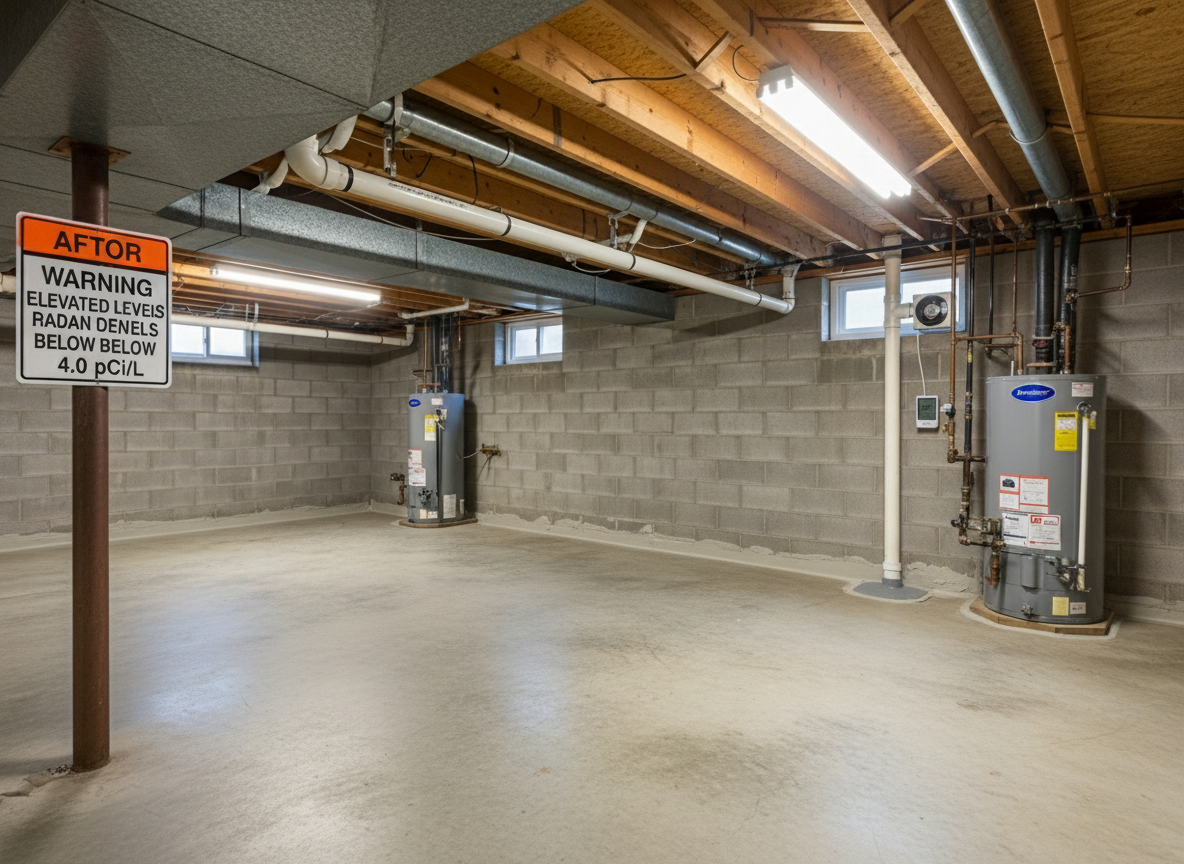
Cedar Rapids home with radon mitigation system installed
Licensed & Insured
Free Estimates
5-Star Rated
Same-Day Service
Satisfaction Guaranteed

Your Test Came Back High. Now What?

You had your home tested — maybe for a real estate transaction, maybe just to be safe — and the number came back above 4.0 pCi/L. Now you're staring at a report that says your family has been breathing elevated radon and you're not sure what to do next.

First: take a breath. You did the right thing by testing.

Radon is the second leading cause of lung cancer in the United States, responsible for about 21,000 deaths per year according to the EPA. It's a naturally occurring radioactive gas that seeps from the soil into homes through foundation cracks, slab joints, and utility penetrations. It's odorless, colorless, and completely invisible — which is exactly why most people don't know they have a problem until they test.

Cedar Rapids sits in EPA Radon Zone 1 — the highest-risk designation in the country. Iowa has some of the highest average radon levels in the US, with Cedar Rapids averaging well above the 4.0 pCi/L EPA action level. The average U.S. home tests at 1.3 pCi/L. If your result is above 4.0, the EPA recommends mitigation. If it's above 8.0, they recommend acting quickly.

Here's the part most people don't know: high radon is not a death sentence for your home. It is completely fixable.

What Happens If You Wait

The instinct after a high radon test is to do more research, get a second opinion, wait and see. That's understandable — it's an invisible threat, and it's hard to feel urgency about something you can't smell or see.

But radon exposure is cumulative. Every month you delay mitigation, your family continues to breathe elevated levels. And radon risk compounds over time — it's not a single exposure event, it's years of accumulated lung tissue exposure to radioactive particles.

What Happens When You Call for Radon Mitigation in Cedar Rapids

From your first call to your post-mitigation test result — here's exactly what the process looks like.

1
You call or request a consultation. We answer, or we call back within 1 hour. Tell us your test result and foundation type. We'll give you a straight ballpark range over the phone before anything else.
2
In-home assessment. A certified technician visits your home to assess your foundation type, identify suction point locations, and plan the system layout. We examine slab thickness, soil conditions, HVAC layout, and where the pipe can exit cleanly.
3
Written quote, you decide. You receive a written quote with the full system scope — no verbal estimates. Sub-slab depressurization, crawl space requirements, and fan specs are all itemized. You decide on your timeline.
4
Installation day. Most installations are completed in a single day. We drill a suction point through your foundation slab, install the PVC pipe system, mount the exterior fan, seal visible cracks and entry points, and verify the system is drawing properly. The home is fully livable the same day.
5
Post-mitigation testing confirms it worked. We perform or arrange post-mitigation testing 24–48 hours after installation. You receive written before-and-after results. If levels are not below 4.0 pCi/L, we return at no charge and adjust. That's our written guarantee.

Professional Radon Services in Cedar Rapids

From testing to full mitigation system installation, we handle every step to make your home safe.

Radon Testing

Accurate short-term and long-term radon testing for homes and commercial properties in Cedar Rapids and Linn County.

Learn More

Radon Mitigation

EPA-compliant radon reduction systems designed and installed to bring your home below the 4 pCi/L action level.

Learn More

System Installation

Complete radon mitigation system installation including sub-slab piping, fan units, and exterior venting.

Learn More

Sub Slab Depressurization

The most effective radon mitigation method — active sub-slab depressurization reduces radon by up to 99%.

Learn More

Radon Fan Replacement

Existing fan failing? We replace and upgrade radon fans for existing mitigation systems across the Cedar Rapids area.

Learn More

Post Mitigation Testing

Verify your system is working. We perform follow-up radon testing 48 hours after installation to confirm safe levels.

Learn More

What Cedar Rapids Homeowners Are Saying

From Kenwood Park to Time Check — real results from homes just like yours

"We tested at 9.8 pCi/L during our home sale — almost stopped the deal. The system was installed in one day, post-mitigation test came back at 0.9. Our buyers were completely satisfied and the sale went through without delays."

— Brian K.  Kenwood Park, Cedar Rapids

"I was anxious about what the installation would look like inside the house. It's one pipe running through the laundry room to outside — you'd never notice it. The crew was professional and walked me through every step. Post-test came back at 1.1 pCi/L."

— Maria V.  Marion, IA

"Our basement tested at 6.4. Three kids at home, so we weren't waiting around. Mitigation was scheduled within the week, done in six hours, and the follow-up test came back at 0.8. Sleep a lot better now."

— David & Erin F.  Time Check, Cedar Rapids

What Does Radon Mitigation Cost in Cedar Rapids?

Costs depend primarily on your foundation type and home size. Here are honest ranges.

Standard Sub-Slab Depressurization

$800 – $2,500

Basement or slab-on-grade foundation. One suction point, exterior fan, pipe routed outside. Most Cedar Rapids homes fall in this range.

Crawl Space Systems

$1,500 – $3,500

Crawl space mitigation typically requires barrier sealing in addition to sub-membrane depressurization. More labor and materials, equally reliable results.

Multiple Suction Points

$2,500 – $4,000

Larger homes or complex foundations may need more than one suction point for even pressure distribution. We tell you exactly what your home requires.

Post-Mitigation Testing

Included or $150–$300

Included in many quotes. A written test result is your proof the system worked. We always recommend confirming with a test.

What's not included in cheap quotes you might find elsewhere: the diagnostic work that makes the system actually effective. A system installed without proper suction diagnostics may look right and still fail to reduce levels. We verify draw before we leave.

Our Work — Before & After

Real radon levels measured in Cedar Rapids homes — before and after sub-slab depressurization

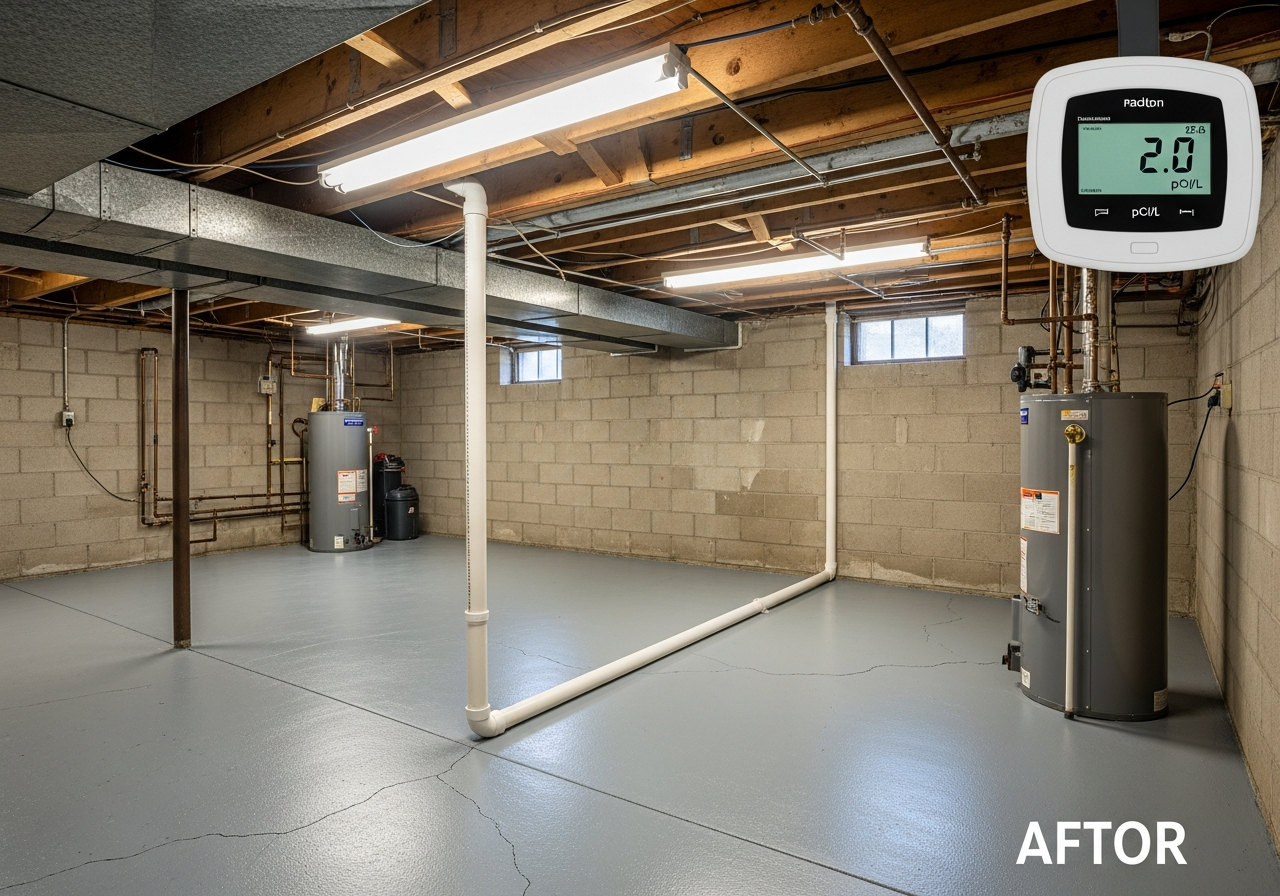
Before radon mitigation — meter reading 4.8 pCi/L in Cedar Rapids basement BEFORE Pre-mitigation: 2.0 pCi/L
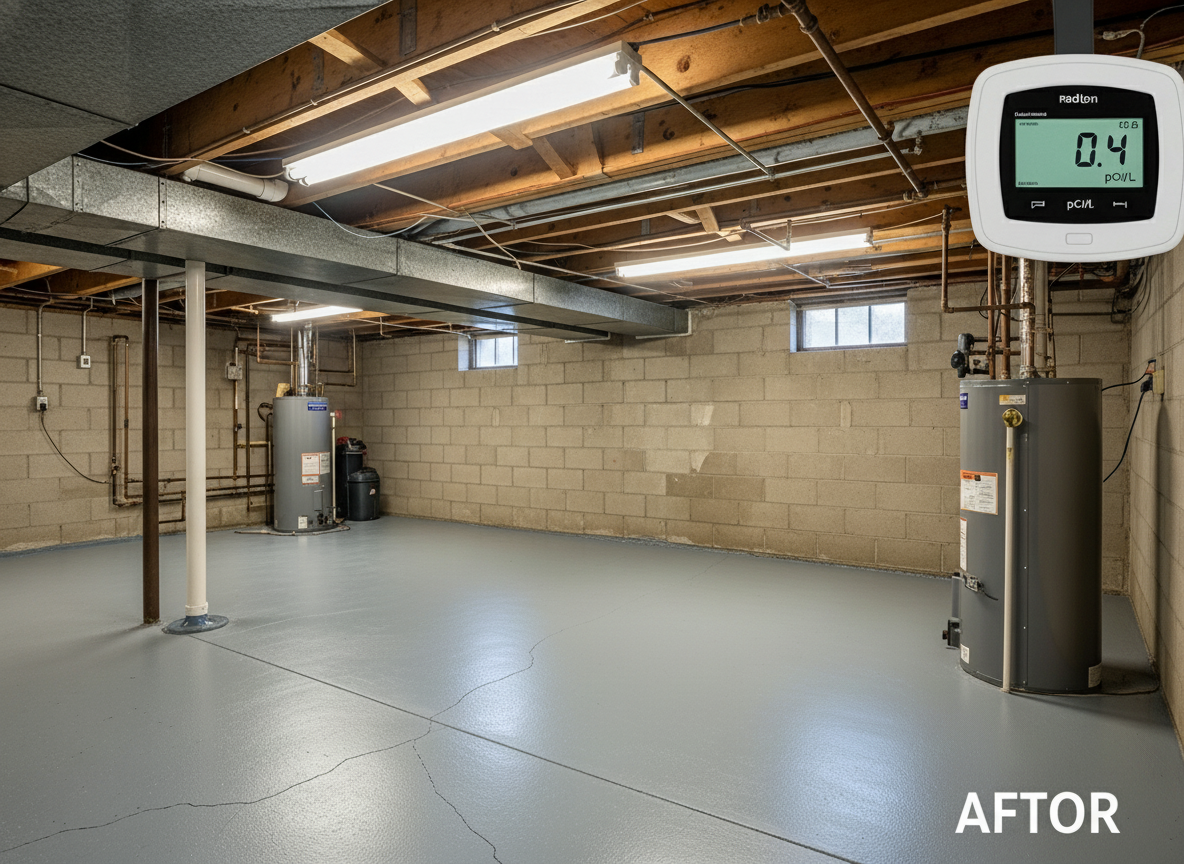
After radon mitigation — meter reading 0.4 pCi/L in Cedar Rapids basement AFTER Post-mitigation: 0.4 pCi/L
Radon reduced 80% — verified post-mitigation test

Questions Homeowners Ask Before Mitigating

Straight answers to what's actually holding people back.

The EPA action level is 4 pCi/L. Iowa averages 7.6 pCi/L statewide — one of the highest in the US. Cedar Rapids and Linn County regularly test well above 4 pCi/L. The US home average is just 1.3 pCi/L, so Iowa homes face nearly 6x the national average. Mitigate at 4 pCi/L or above; act immediately above 8 pCi/L.
Radon mitigation in Cedar Rapids typically costs $800–$2,500 for a standard sub-slab depressurization system. Crawl space systems run $1,500–$3,500. Multiple suction points for larger homes cost $2,500–$4,000. Post-mitigation testing is often included or runs $150–$300 separately. We provide written quotes with full itemization.
Most radon mitigation system installations are complete in 4–8 hours — a single day. You can return to the home immediately after installation. Post-mitigation testing is performed 24–48 hours later to confirm radon levels are below 4 pCi/L. There is no curing period or off-limits area after installation.
Yes — we serve all of Linn County including Cedar Rapids, Marion, Hiawatha, Center Point, Ely, Mount Vernon, Lisbon, and Solon. We also serve Benton County and Jones County, plus Johnson County communities including North Liberty and Coralville. Most service calls are scheduled within 48 hours.
Yes — sub-slab depressurization is the EPA-recommended method and reduces radon 90%+ in the vast majority of homes. We back every installation with a written guarantee: post-mitigation levels below 4 pCi/L or we return at no charge and adjust the system until it passes. You receive written before-and-after test results.
Sub-slab depressurization is the gold-standard radon reduction method. A technician drills one or more suction points through your foundation slab, installs PVC piping, and mounts a small exterior fan. The fan creates negative pressure below the slab, drawing radon out before it enters the living space and venting it safely above the roofline. The fan runs continuously on about $5–$15 of electricity per month.
Not necessarily. Short-term test kits are available at hardware stores for $15–$30 and provide results in 48–96 hours. Long-term kits ($25–$50) give more accurate readings over 90+ days. If your home is in Linn County and hasn't been tested, the probability of elevated radon is high enough that testing is strongly recommended. We can also arrange professional testing.
Radon mitigation systems are more discreet than most homeowners expect. A 3–4 inch PVC pipe runs from the slab through an interior utility space and exits through the wall or roof. A small fan is mounted outside or in a utility area. Most homeowners barely notice the system after installation, and pipe routing can often be planned to minimize visibility.
Iowa law requires sellers to disclose known radon hazards. Most buyers in Linn County request radon testing as part of the inspection process. A pre-sale mitigation system with documented post-mitigation test results below 4 pCi/L often removes the issue entirely and prevents last-minute deal complications. We provide fast turnaround for real estate transactions.
If post-mitigation testing shows levels above 4 pCi/L, we return at no charge to adjust the system. This may involve increasing fan capacity, adding a second suction point, or sealing additional entry points. Our written guarantee covers this. Systems properly sized and installed for a home's foundation type achieve results below 4 pCi/L in the large majority of cases on the first installation.
Quality radon fans are designed to run continuously and typically last 5–10 years. Most systems include a visual pressure indicator so you can verify the fan is drawing properly at a glance. When a fan needs replacement, it's a straightforward swap — typically $200–$400 including parts and labor. Annual inspection is recommended.
Radon fans use about the same power as a light bulb — typically $5–$15/month in additional electricity costs. They run continuously 24/7, which is necessary for the depressurization to be effective. The cost is minimal compared to the health benefit of eliminating radon exposure.

Request Your Free Radon Estimate

Ready to protect your family? Contact us today for a free radon testing and mitigation estimate. We serve Cedar Rapids and all of Linn County.

contact@fiveseasonsradon.com
Mon–Sat: 7:00 AM – 7:00 PM
Cedar Rapids, IA & Surrounding Areas

Your Family Doesn't Have to Keep Breathing Elevated Radon

Every day without mitigation is another day of exposure. The system takes one day to install. The consultation is free, the call takes 10 minutes — we answer or call back within 1 hour.

Call (319) 528-5190

Radon Risk in Cedar Rapids — What You Should Know

Cedar Rapids sits in EPA Radon Zone 1 — the highest-risk designation. The EPA estimates homes in Zone 1 counties have a strong potential for elevated indoor radon levels, and testing is strongly recommended for all homes. Iowa ranks among the top states in the nation for average indoor radon concentrations, with Cedar Rapids averaging well above the 4.0 pCi/L action level.

Local soil conditions in Iowa contribute significantly to radon potential. Uranium-bearing rock and glacial till — common throughout the Midwest — are primary radon sources. Homes with basements are at higher risk than slab or crawl-space homes, simply because the lowest livable level is in direct contact with the soil. Neighborhoods like Kenwood Park and Time Check sit on the same geological base as the rest of Linn County — and the same radon risk applies.

We've installed mitigation systems across Cedar Rapids, Marion, Hiawatha, Robins, and surrounding Linn County communities. We know the foundation types common to different neighborhoods, the soil conditions that drive higher readings, and the system configurations that perform reliably in Cedar Rapids's climate. If your test came back elevated, call us — the system takes one day to install and the results are guaranteed.

Call Now Free Quote